


Gallery 2021




Speakers 2021
Professor Farid ABDI

Functional perovskite materials: synthesis and properties
The definition of functional materials reflects the ability of a material to perform a specific function under a given stimulus. In this broad definition, a wide range of materials can be included, together with a broad range of properties and applications.
However, the classification of functional materials is generally associated with materials whose function is linked to their electrical, magnetic, and/or optical properties. This group mainly includes dielectrics, pyroelectrics, piezoelectrics, ferroelectrics, relaxor ferroelectrics, semiconductors, ionic conductors, superconductors, electro-optic materials, and magnetic materials.
The usefulness of these functional materials in applications reflects their unique properties, such as spontaneous polarization, piezoelectricity, superconductivity, and magnetoresistance. All these properties depend directly on chemical composition, crystallographic structure features, and processing methods. Understanding the relationships between composition, structure, processing, and properties enables the production of improved, high-performance materials for targeted applications.
This conference is not intended to cover all functional materials, but rather selected materials that are technologically important today. In this perspective, and in relation to end-use applications, the focus is placed on key properties such as piezoelectricity, pyroelectricity, and ferroelectricity, as well as the (hybrid) perovskite material family, their formulations, and their fabrication.
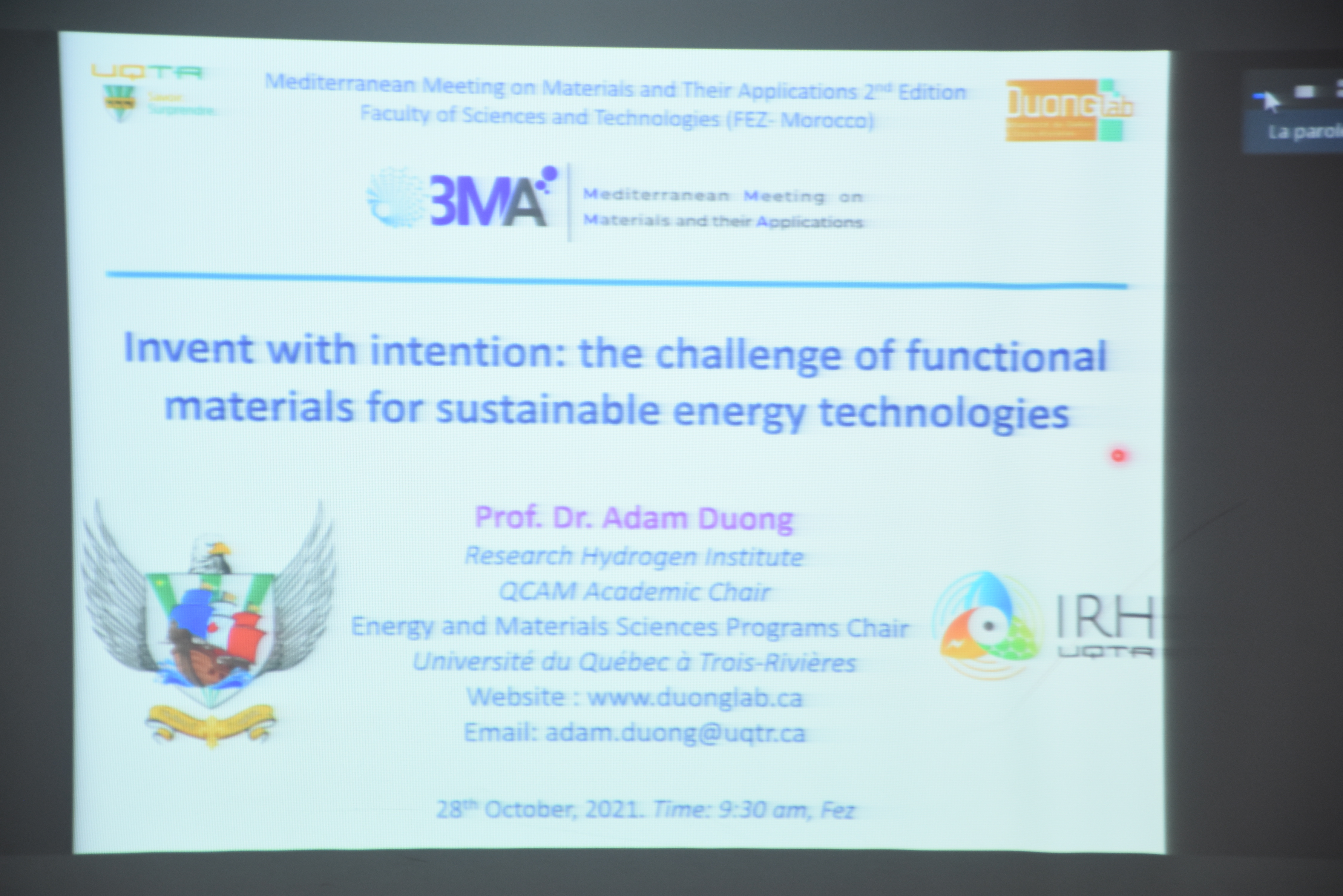
Professor Adam Duong

Invent with intention: the challenge of functional materials for sustainable energy technologies
The team of Professor Adam Duong (DuongLab), of the Hydrogen Research Institute at the University of Quebec at Trois-Rivières, is specialized in the design of functional materials for the development of sustainable energy technologies. DuongLab invents advanced materials with the intention to produce molecular hydrogen, convert carbon dioxide into value-added products, store energy and separate gases. To do this, the team uses the strategies of supramolecular and reticular chemistry to build structures with adequate properties for the energy applications. This presentation covers the design, synthesis and characterization of photocatalysts and porous materials for H2 production, CO2 capture and its separation in binary mixtures and the electrical storage.
Program 2021 (PDF)
If the PDF does not appear, open programme-2021.pdf.